Click on My Mouth: Language and Technology
March 17- May 22, 2026
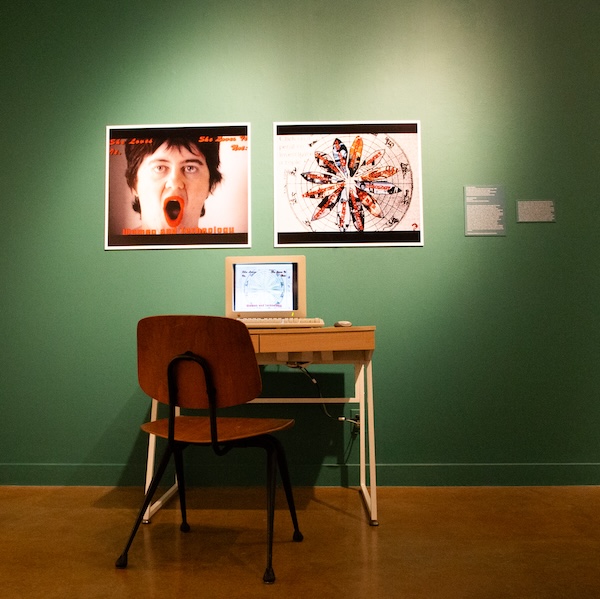
Christine Tamblyn, She Love It: She Loves It Not: Women and Technology, 1993, CD-ROM (2025-26 emulation from disk image). In collaboration with Marjorie Franklin and Paul Tompkins. Sponsored by San Francisco State University’s Faculty Multimedia Research and Development Center. 1993, printed 2026, Inkjet prints, Courtesy of the estate of Christine Tamblyn. Photo by Allison Dietrich
The Natalie and James Thompson Art Gallery at San José State University is pleased to present Click on My Mouth: Language and Technology (March 17– May 22, 2026). Guest curated by Tanya Zimbardo, the exhibition features artworks made in the Bay Area by Anxious to Make (Liat Berdugo + Emily Martinez); Ahna Girshick; Asma Kazmi, Jill Miller and Kathy Wang; Judy Malloy; Jenny Odell; Genevieve Quick; Abram Stern; and Christine Tamblyn.
“Click on my mouth” playfully intones a video image of Christine Tamblyn (1951–1998)
as the virtual guide for the menu of her interactive work She Loves It, She Loves
it Not: Women and Technology (1993; with Marjorie Franklin and Paul Tompkins). As
an outgrowth of her cultural criticism, Tamblyn explored how the interactive CD-ROM
format could allow her to augment her writing with found pictures and audio/video
clips ranging from science fiction films, comics, computer magazines and books about
robots. For this feminist, nonlinear essay, she subverted the use of Macromedia Director,
associated with corporate training, to discuss the “historical exclusion of women
from the technological realm. However, it also attempts to create a place for women
within cyberspace by constructing a revisionist history.”
A newly reauthored version of She Loves It, She Loves It Not is the springboard for
a group exhibition that explores the ways in which artists have worked with appropriation
and archives associated with technology. Artists Asma Kazmi and Jill Miller with designer
Kathy Wang have created with an intersectional, feminist lens, a web-based repository
of handmade 3D modeled objects that span a wide range of identities, abilities, and
affinities. Their Missing Objects Library (2023-) proposes an alternative to commercial,
status quo storefronts that provide digital assets for game design and special effects.
Genevieve Quick’s promotional format video for her Cell Bell (2023-) project describes
a speculative global telecom that allows viewers to send voicemail messages to their
ancestors or future generations.
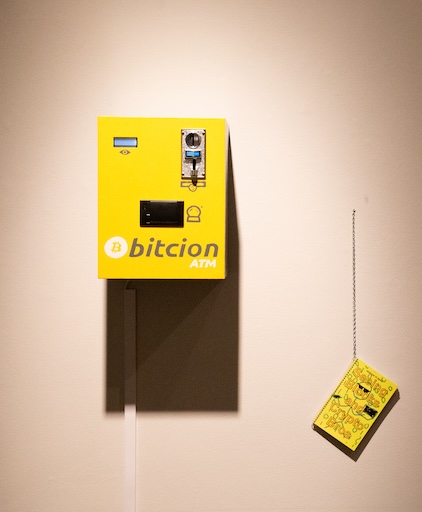
Anxious to Make (Liat Berdugo + Emily Martinez), Bitcoin Futures, 2018. Seeing Blocks and Crypto Bros, 2018. Artist book, Courtesy the artists (Liat Berdugo + Emily Martinez). Photo by Allison Dietrich
A pioneer of electronic literature, Judy Malloy in the 1980s formed her own research
and development companies to acquire vendor information like an insider of the Bay
Area tech community. For OK Genetic Engineering, she collected information about genetic
engineering research and development to make a series of reports and products – small
experimental books that combined words and images and were distributed as free handouts
or by mail. Decades later, Jenny Odell created Neo Surreal (2017), a suite of prints
drawn from the imagery of 1980s personal computer advertisements from BYTE magazine
Odell encountered during a residency at the Internet Archive in San Francisco. Anxious
to Make invites visitor participation through Bitcoin Futures (2018), a functional
ATM that dispenses crypto prophecies like a fortune-telling machine. Visitors see
their reflection in the mirror of Ahna Girshick’s Bias Reflector, II (2025) entangled
with the machine-learned lexicon of visual patterns that dictate perception.
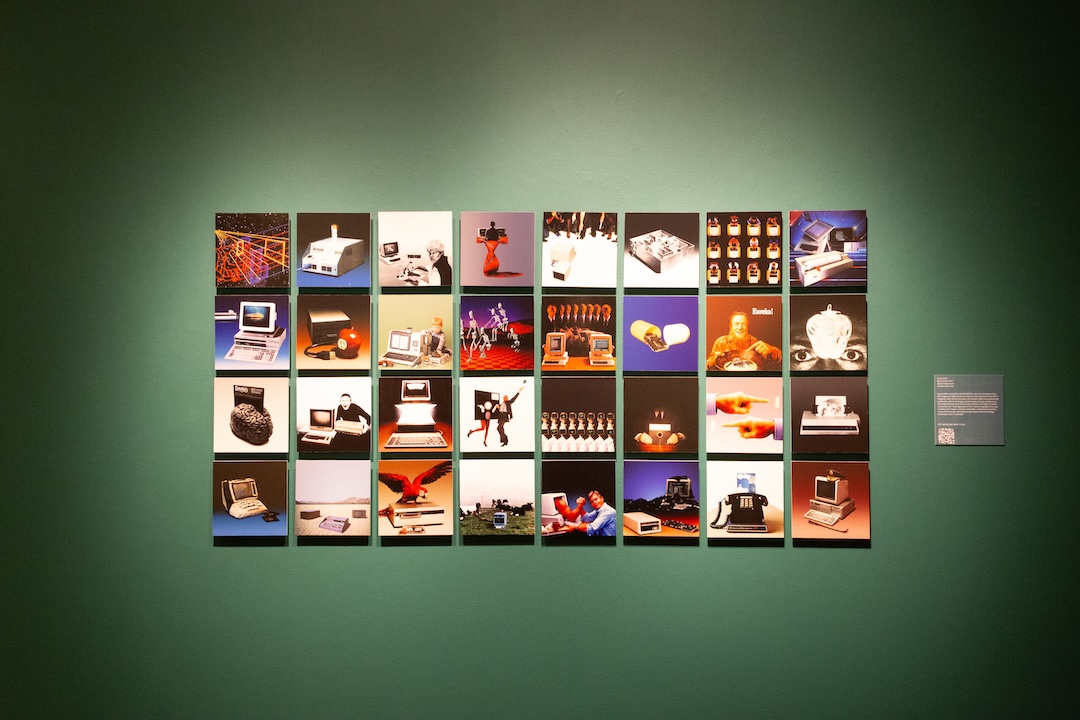
Jenny Odell, Neo Surreal, 2017. Photo by Allison Dietrich
Finally, Abram Stern’s new video will surface their research and emulation process of working with Tamblyn’s digital artifacts, including related archival material from Stern’s mentor Margaret Morse. The exhibition offers students the opportunity to learn about key contemporary works made locally by a range of artists, several of whom, like the late critic Tamblyn, have additionally contributed to the field as writers and educators.
She Loves It, She Loves It Not: Women and Technology is the latest case study in a
collaboration between Rhonda Holberton, SJSU Associate Professor, Digital Media Arts,
Vanessa Chang & Alexa Bonomo (Leonardo/ISAST), Elvia Arroyo-Ramirez (UC Irvine), and
Abram Stern (UC Santa Cruz). Funded by the Knight Foundation and stewarded by SJSU
CADRE Media Lab and Leonardo/ISAST, invited artists work with students to reauthor
works using several novel methods being developed by the archiving team. Tamblyn’s
reauthored work will be available as both an emulation and a web-based version archived
on New Art City, a virtual exhibition toolkit originally developed by Don Hanson,
an MFA candidate in the Digital Media Art program at SJSU, during the COVID Pandemic
in 2020.
This Natalie and James Thompson Art Gallery presentation is part of a series of exhibitions
and events planned for the 2025-2026 academic year that mark the occasion of the 40th
anniversary of SJSU’s CADRE (Computers in Art, Design, Research, and Education) Media
Lab, the hub of Digital Media Art activity at San José State University where students,
faculty, and visiting artists gather to explore the future of technology and art.